
ManningBooks
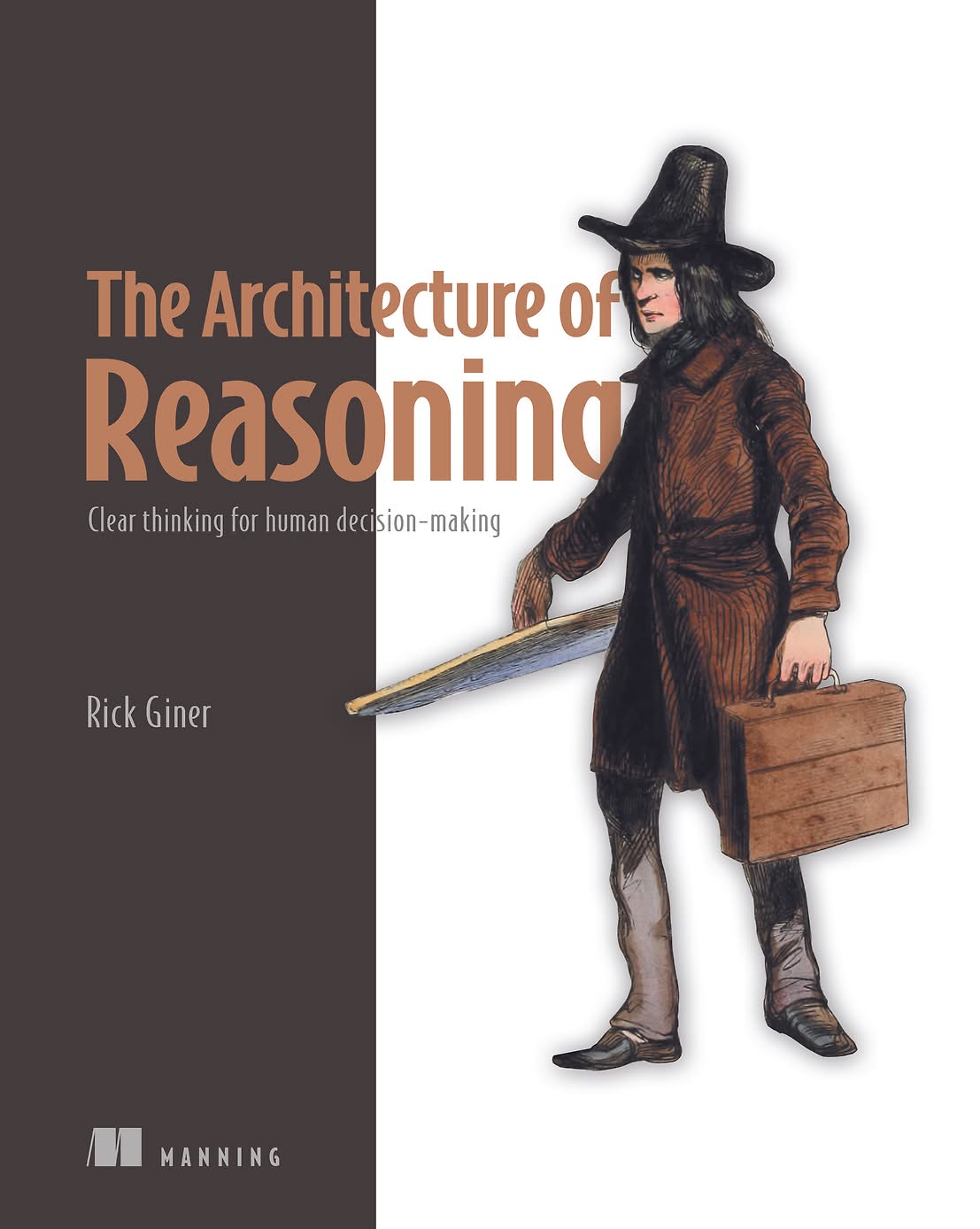
The Architecture of Reasoning (Manning)
Imagine a team agreeing to simplify a service. One person means reducing operational overhead. Another means making the code easier to change. A third means removing features. They’ve agreed on the words, but have they agreed on the decision?
That gap between apparent agreement and shared understanding is a central concern of Rick Giner’s The Architecture of Reasoning: Clear thinking for human decision-making. The book explores what happens when assumptions and trade-offs stay hidden behind a conclusion—and how to make that thinking easier to examine.
Rick Giner
The book draws on reasoning patterns explored in AI research, but its focus is human judgment, including decisions that involve no AI at all. Giner examines different ways to structure thinking: making intermediate steps explicit, exploring alternative paths, deliberately changing perspectives, and testing ideas against evidence. The point is to choose an approach that fits the problem rather than treat every decision as the same kind of exercise.
Consider a hypothetical service rewrite. Before comparing frameworks, a team might need to unpack the claim that the existing system is “holding us back.” Is the problem deployment risk, slow feature delivery, maintenance cost, or something else? Exploring alternatives is useful only after the team agrees on what those alternatives need to achieve.
Importantly, the book doesn’t argue for making every decision more elaborate. Its principle of the “smallest sufficient architecture” is about using enough structure to reason well without adding unnecessary process. A straightforward question may need a straightforward answer; an uncertain, consequential decision may need more exploration or evidence.
It also looks beyond techniques to the conditions in which decisions happen. Attention, status, time pressure, and evidence quality can undermine even a carefully structured discussion. Clear reasoning needs an environment where people can question assumptions, not merely a template that asks them to.
That leaves an interesting question for developers: if someone reviewed the reasoning behind your last major technical decision, rather than just the outcome, what would they be able to see—and what would still be trapped in people’s heads?
- Full details: The Architecture of Reasoning - Rick Giner
Don’t forget you can get 45% off with your Devtalk discount! Just use the coupon code “devtalk.com” at checkout 
Popular General Dev topics


Other popular topics


Sponsor Spotlight

We build reliable cloud platforms for business-critical systems.

Categories:
Sub Categories:
- All
- In The News (11519)
- Dev Chat (208)
- Questions (39)
- Learning Resources
- Blogs/Talks (29)
- Jobs (3)
- Events (15)
- Code Editors (59)
- Hardware (61)
- Reviews (5)
- Sales (16)
- Design & UX (5)
- Marketing & SEO (2)
- Industry & Culture (14)
- Ethics & Privacy (19)
- Business (4)
- Learning Methods (7)
- Content Creators (7)
- DevOps & Hosting (14)
Popular Portals
- /elixir
- /rust
- /wasm
- /ruby
- /erlang
- /phoenix
- /keyboards
- /python
- /js
- /rails
- /security
- /go
- /swift
- /vim
- /java
- /clojure
- /typescript
- /emacs
- /haskell
- /svelte
- /onivim
- /kotlin
- /react
- /c-plus-plus
- /crystal
- /tailwind
- /gleam
- /ocaml
- /elm
- /vscode
- /flutter
- /html
- /ash
- /deepseek
- /zig
- /opensuse
- /php
- /centos
- /react-native
- /scala
- /lisp
- /sublime-text
- /textmate
- /nixos
- /debian
- /agda
- /deno
- /django
- /kubuntu
- /nodejs
- /arch-linux
- /ubuntu
- /spring
- /revery
- /manjaro
- /julia
- /quarkus
- /diversity
- /lua
- /laravel
Devtalk Sponsors

Practical resources that improve the lives of professional developers.

We build trusted fault-tolerant systems that scale to billions of users.

Real-time error tracking, performance insights, and observability for devs.

Supporting innovation across the BEAM ecosystem.
We build reliable cloud platforms for business-critical systems.

Develop your skills with books, videos, and courses.

Catch errors, track performance, monitor hosts and more.

Enabling companies to succeed by building software people love.

Courses that move you from confusion to "Aha, now I get it!"

Publishing Linux Magazine, ADMIN, and MakerSpace for 25+ years.