
ManningBooks
Embedded Software with Rust (Manning)
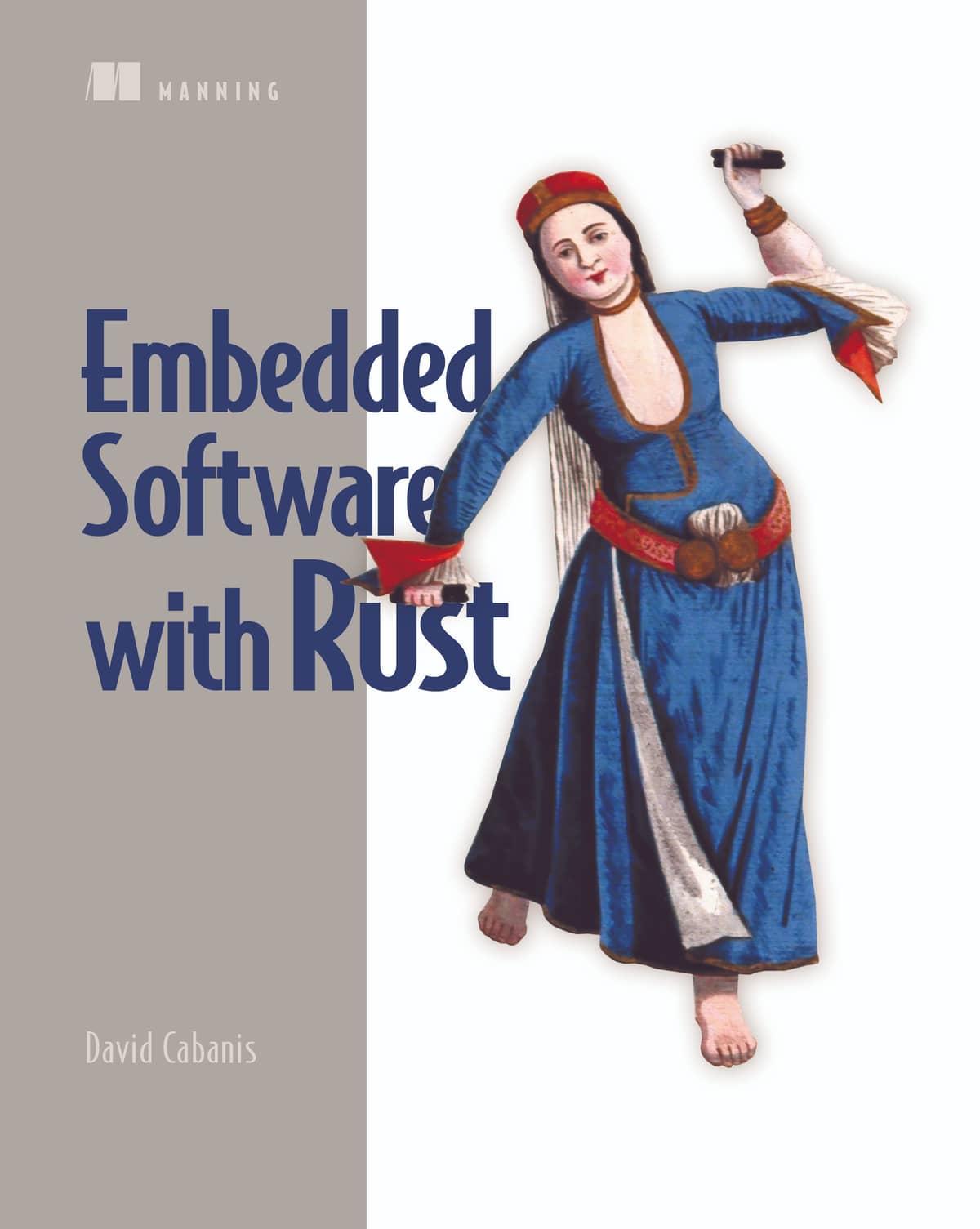
Embedded Software with Rust is a practical introduction to building firmware that is fast, efficient, and far safer than traditional embedded software written in C or C++. Rust gives developers the low-level control embedded systems demand, but adds modern guarantees around memory safety, data races, and error handling. In a field where a single bug can cause crashes, security flaws, or costly field failures, those guarantees are a major advantage.
David Cabanis
Embedded firmware has always demanded close control over hardware: memory-mapped registers, interrupts, linker scripts, startup code, timing, and strict resource limits. Traditionally, that has meant C or C++, along with all the familiar risks around pointer misuse, undefined behavior, data races, and fragile error handling.
Rust offers another path. It gives embedded developers low-level control while adding compile-time checks for memory safety, ownership, borrowing, and concurrency. For firmware running in consumer devices, industrial systems, vehicles, medical equipment, robotics, and edge platforms, those guarantees matter.
Embedded Software with Rust is a practical guide to building bare-metal firmware in Rust. It starts with the foundations and moves steadily toward working hardware-focused development, showing how Rust’s language features connect directly to embedded tasks.
Inside the book, you’ll learn how to:
-
Set up an embedded Rust development environment
-
Build and inspect firmware with Cargo, cargo-binutils, GNU tools, OpenOCD, probe-rs, and QEMU
-
Configure
no_stdprojects for bare-metal execution -
Understand the reset-to-
main()path on Cortex-M systems -
Define memory layouts with linker scripts and
memory.x -
Work with startup code, vector tables, exceptions, and interrupts
-
Share data safely between main code and interrupt handlers
-
Use PACs, HALs, BSPs, and
embedded-haltraits -
Manage memory in constrained systems
-
Interoperate with C as part of a migration path
The book is hands-on throughout. Early chapters walk through toolchain setup, project structure, no_std configuration, linker scripts, and minimal startup. Later chapters expand into memory-mapped I/O, debugging, profiling, stack and heap management, async and RTOS compatibility, performance tuning, and Rust-C integration.
A big strength of the book is that it explains what is happening underneath the abstractions. You won’t only use cortex-m-rt, embedded-hal, or a board support crate; you’ll also see how the reset handler, vector table, .data copying, .bss zeroing, panic behavior, and interrupt dispatch actually fit together.
The book is written for software engineers with basic Rust knowledge. Prior embedded experience helps, but the text introduces the needed background step by step. Experienced firmware engineers coming from C or C++ will also find plenty of familiar ground, especially around build/debug workflows, hardware registers, linker configuration, and interrupt-driven design.
About the author: Dr David Cabanis is Principal Engineer at Doulos, specializing in Arm embedded software, FPGA and SoC design, and system-level modeling. He is an ARM Accredited Engineer, MCU Engineer, and former ARM Certified Trainer, with deep practical experience in embedded Rust.
- Full details: Embedded Software with Rust - David Cabanis
Don’t forget you can get 45% off with your Devtalk discount! Just use the coupon code “devtalk.com” at checkout 
Popular Backend topics


Other popular topics




Sponsor Spotlight

We build trusted fault-tolerant systems that scale to billions of users.
Latest in Rust

Categories:
Sub Categories:
Popular Portals
- /elixir
- /rust
- /wasm
- /ruby
- /erlang
- /phoenix
- /keyboards
- /python
- /js
- /rails
- /security
- /go
- /swift
- /vim
- /java
- /clojure
- /typescript
- /emacs
- /haskell
- /svelte
- /onivim
- /kotlin
- /react
- /c-plus-plus
- /crystal
- /tailwind
- /gleam
- /ocaml
- /elm
- /vscode
- /flutter
- /html
- /ash
- /deepseek
- /zig
- /opensuse
- /centos
- /php
- /react-native
- /scala
- /lisp
- /textmate
- /sublime-text
- /nixos
- /debian
- /deno
- /agda
- /django
- /kubuntu
- /nodejs
- /arch-linux
- /ubuntu
- /spring
- /revery
- /manjaro
- /julia
- /lua
- /quarkus
- /diversity
- /laravel
Devtalk Sponsors

Practical resources that improve the lives of professional developers.
We build trusted fault-tolerant systems that scale to billions of users.

Real-time error tracking, performance insights, and observability for devs.

Supporting innovation across the BEAM ecosystem.

We build reliable cloud platforms for business-critical systems.

Develop your skills with books, videos, and courses.

Catch errors, track performance, monitor hosts and more.

Enabling companies to succeed by building software people love.

Courses that move you from confusion to "Aha, now I get it!"

Publishing Linux Magazine, ADMIN, and MakerSpace for 25+ years.