
ManningBooks
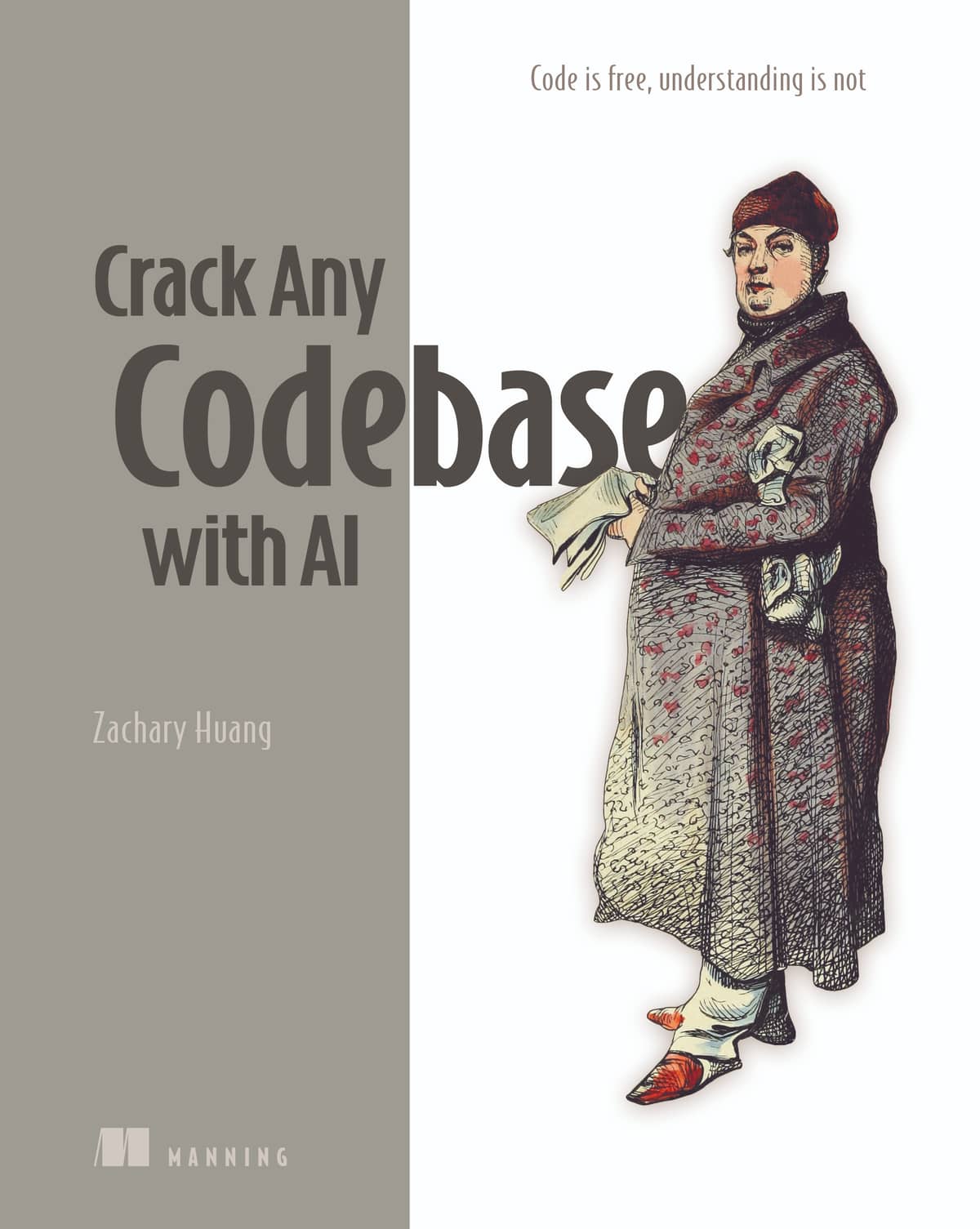
Crack Any Codebase with AI (Manning)
Crack Any Codebase with AI shows you how to use an efficient AI-driven process to quickly and accurately make sense of any software project in just a few hours, complete with prompts, workflow pipelines, and mental models.
Zezhou (Zach) Huang
This book tackles a problem many developers know too well: you’re asked to work in a codebase you didn’t write, the docs are stale, the original authors are gone, and the AI-generated parts look plausible but nobody can fully explain them. The code may run. The understanding is missing.
Zachary Huang, an AI researcher at Microsoft Research AI Frontiers, argues that the developers who do well with AI won’t be the ones who blindly accept more generated code. They’ll be the ones who can question it, map systems quickly, catch bad assumptions, and build a correct mental model before shipping changes.
The book gives you a practical workflow for doing that.
You’ll learn how to:
-
Map an unfamiliar repo on one page in under an hour
-
Use AI chat well, instead of asking vague “explain this code” prompts
-
Build a small Codebase Knowledge Builder workflow that turns a repo into a tutorial
-
Use agents for focused traces, tests, and build/run exploration
-
Reverse-engineer product intent from code, schema, and git history
-
Generate ERDs, sequence diagrams, component trees, DAGs, and architecture maps
-
Understand backend, frontend, ML, library, and infrastructure code through repeatable patterns
-
Ship a PR to an unfamiliar open-source project with tests that prove the change is safe
The examples use production open-source projects, including Next.js, pytest, Rails, React, nanoGPT, VS Code, and Cal.com. The book includes prompts, annotated code listings, diagrams, and small tools you can adapt for your own repos.
One idea I especially like is “comprehension debt.” Technical debt is code you know is messy. Comprehension debt is code that works, but nobody understands why. AI makes that problem more urgent because teams can now create much more code than they can explain. The book treats AI’s flaws as training reps: every hallucinated API, wrong assumption, or overcomplicated fix becomes a chance to sharpen your engineering judgment.
If you’re onboarding to a new team, debugging a legacy system, reviewing AI-written code, or trying to make sense of a repo before touching it, this one is for you.
- Full details: Crack Any Codebase with AI - Zezhou (Zach) Huang
Don’t forget you can get 45% off with your Devtalk discount! Just use the coupon code “devtalk.com” at checkout 
Popular Ai topics

Other popular topics





Sponsor Spotlight

Develop your skills with books, videos, and courses.

Categories:
Sub Categories:
Popular Portals
- /elixir
- /rust
- /wasm
- /ruby
- /erlang
- /phoenix
- /keyboards
- /python
- /js
- /rails
- /security
- /go
- /swift
- /vim
- /java
- /clojure
- /typescript
- /emacs
- /haskell
- /svelte
- /onivim
- /kotlin
- /react
- /c-plus-plus
- /crystal
- /tailwind
- /gleam
- /ocaml
- /elm
- /vscode
- /flutter
- /html
- /ash
- /deepseek
- /zig
- /opensuse
- /centos
- /php
- /react-native
- /scala
- /lisp
- /sublime-text
- /textmate
- /nixos
- /debian
- /agda
- /deno
- /django
- /kubuntu
- /nodejs
- /arch-linux
- /ubuntu
- /spring
- /revery
- /manjaro
- /julia
- /quarkus
- /lua
- /diversity
- /laravel
Devtalk Sponsors

Practical resources that improve the lives of professional developers.

We build trusted fault-tolerant systems that scale to billions of users.

Real-time error tracking, performance insights, and observability for devs.

Supporting innovation across the BEAM ecosystem.

We build reliable cloud platforms for business-critical systems.
Develop your skills with books, videos, and courses.

Catch errors, track performance, monitor hosts and more.

Enabling companies to succeed by building software people love.

Courses that move you from confusion to "Aha, now I get it!"

Publishing Linux Magazine, ADMIN, and MakerSpace for 25+ years.